Kargil war: A summary of a story that needs to told.
A Brief History
Before the Kargil war, India and Pakistan had fought 3 other major wars in 1947,1965 and 1971. 47' and 65' were fought only for Kashmir whereas 71' was fought on both the eastern and western fronts and the result of the war was, we divided Pakistan into 2 parts that are the present-day parts of Bangladesh and Pakistan. The war of 1947 also known as the first war of Kashmir which ended with Pt JW Nehru taking the issue to the UN which is till date seen as if not the biggest, one of the biggest blunders of post-independent India which we'll keep for some other day. In 65' Pakistan saw our defeat in 62' against the Chinese and saw that as an opportunity to attack India but this war is said to have ended in a stalemate. Experts however, regard this as an Indian victory. Apart from these wars, one needs to know about Operation Meghdoot that happened in 84' and Operation Rajiv that happened in 87' in Siachen.
Siachen
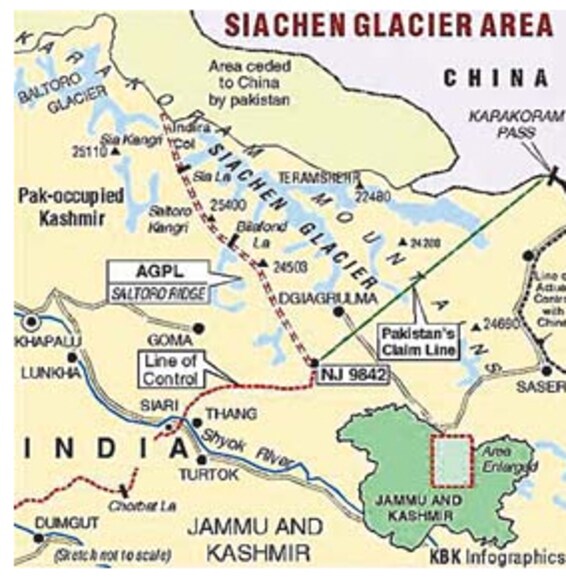
During the Karachi agreement of 49' or the Shimla agreement of 72' there was no clear demarcation of the ceasefire line or the LOC in the Siachen area, it just said it “continues northward”, which means the territory belongs to India. Siachen is basically the triangular piece of land between point NJ 9842, Indira col and Karakoram pass, separating POK from merging with the Aksai Chin region. So, this land is strategically very important for both India and Pakistan. R&AW received intelligence that the Pakistani Army is going to launch an offensive mission to capture Siachen. With no obvious surprises, it failed.
They tried to annexe this territory twice: once in 84' and once in 87'. One must also note here Siachen is the world's highest battlefield about 6000m high, the temperatures go up to -50° here and human survival in this condition Itself is a challenge here, we must be proud and of our forces that they are standing in harm's way to protect us day in and day out. Currently, the line separating POK and India there is the AGPL (Actual Ground Position Line) ; it is different from the LOC.
The Backdrop of The War
The 90s saw a rise in the insurgency in the state of Jammu and Kashmir, there are many reasons for this which in itself is a separate blogspot. But the basic premise was that many terror groups like the Hizbul Mujahideen, LeT, JeM had marked their presence. The political situation also wasn't great. Atal Bihari Vajpayee Ji's government had fallen for the second time, this time the government stood for 13 months compared to last time's 13 days. Before the government fell, towards the end of February, the PM had visited Pakistan to improve our relations with them and signed the Lahore declaration. One must also not forget both these countries were countries that had tested their nuclear weapons about a year back (98').
Events Leading upto the War
During winters both India and Pakistan withdraw their forces from the posts located in very high altitudes in the front and occupy them back in the spring season. One can say this was like an unwritten agreement, but that year Pakistan occupied the posts earlier than usual. On the 3rd of May 1999, a few local shepherds saw unusual activity on those posts and reported them to the nearest Indian Army camp in Battalik.
On the 5th of May, the Indian Army sent a patrol party to investigate the intel from the shepherds, but they were captured and held hostage. In that week after a lot of artillery shelling took place along the LOC, Pakistan kept saying they had “no role” here. They claimed themselves to be mujahideens, fighting for "Azadi". India got back the mortal remains of the members of the search party which went on the 5th of May. I shouldn't be calling it remains; their eyes were punctured, cigarette marks all over the body which was against any Rule of War.
On 17th and 18th of May, India noticed that the so-called mujahideens had occupied posts on high altitudes from where one can target NH-1 which connects Srinagar to Ladakh, losing control over that would mean losing control over Siachen and obviously Ladakh. These so-called mujahideens were heavily equipped with advanced weapons like anti-aircraft guns and stinger missiles. India realises this is not any ordinary infiltration and launches Operation Vijay on 19th May.
Operation Vijay
OP Vijay was launched by the Indian army where it mobilised 2 lakh troops in the Kargil region. Before getting into the details of OP Vijay I'll tell you a little bit of Op Safed Sagar.
Op Safed Sagar was the name of the mission launched by the Indian Air Force. IAF was involved in Kargil from as early as 11th May, and it had provided only support. On the 25th of May, IAF got permission to attack but without crossing the LOC upon the recommendation of the then Air Chief Marshal AY Tipnis sir. On the 27th of May, we lost 2 jets and a pilot (Sqn Ldr Ajay Ahuja, Vir Chakra) and the other pilot was held captive. The next day we lost a helicopter and 4 men. On the 30th of may, IAF had created history.
Our Mirage 2000 aircrafts dropped laser-guided bombs on strategic locations, this was the first time IAF was using LGBs; these were provided by Israel to us at the time when we needed them the most. Retd Air Marshal R Nambiar who piloted one of the jets that dropped the LGB said they did even have the time to have a simulator practice before the actual mission which seems worth mentioning.
Now getting back to OP Vijay, from the 1st to 5th of June there was heavy artillery shelling across the border, but the 5th of June was important because the Indian Army recovered a few documents from the mortal remains of the so-called mujahideens which had conclusive evidence to say these are not mujahideens, but instead regular Pakistani Army soldiers. On the 6th, Indian army started a full-fledged attack. By the 9th of June, we regained control over two key posts in the Batalik Sector.
On the 11th of June India intercepted a phone call made by Gen Musharaf to his deputy which PROVED Pakistan’s direct involvement in this conflict. On the 13th of June, India recaptured Tololing Top under the leadership of major Vivek Gupta, MVC. On the 29th, the Pakistani Government stopped its ration supply to its army upon the "advice" from US President Bill Clinton, credited to the diplomacy played by Atal Bihari Vajpayee Ji. It's said in various sources that he was ready to use nuclear weapons, in fact, he had made a plan with the then army chief Gen VP Malik named a 6-day plan which we would use if we lost Kargil.
On the 4th of July, India recaptured Tiger Hill, an extremely strategic point. In the battle of Tiger Hill, Yogendra Singh Yadav sir was awarded the Param Vir Chakra. He took 21 bullets, yet indulged the enemies in hand to hand combat and hoisted the tricolour on Tiger Hill. This gallant soldier was just 17, making him the youngest PVC out of the 21 PVCs. On the 11th of July India gained back complete control over the Batalik Sector and on the 14th, Vajpayee ji declared OP Vijay as a success and set terms and conditions for talks with Pakistan. All of this culminated on the 26th July which is celebrated as KARGIL VIJAY DIVAS.
The tricolour stands tall and waves not because of the wind, but because of the last breath of every soldier who died protecting it. India lost 527 soldiers. The stories of Captain Vikram Batra who said "I'll either hoist the tricolour or come back wrapped in it", Captain Manoj Kumar Pandey wrote in his diary before his martyrdom, "If death strikes before I prove my blood, I promise, I will kill death". We must take inspiration from these stories and keep contributing to our country in some way or the other, we must also be proud of our army not only because they slew the enemy also because we proved our morality as an army, when Pakistan refused to accept the mortal remains of its own soldiers, the Indian army cremated them with full military honour.
Jai Hind.


Good one Jaya. Keep it up. Good research done. Mention your sources too. It helps.
ReplyDeleteThanks uncle, thanks for your suggestion too I would try to do the same henceforth.
DeleteGood start Jaya 👏👏 keep up and many more to come
ReplyDeleteThanks :)
DeleteCongratulations for your efforts, write about 26/11 also some time
ReplyDeleteCongratulations for your efforts, write about 26/11 also some time
ReplyDeleteThanks uncle, sure :)
DeleteBro!!Damn good one!!!So detailed and too good!! Keep up the good work. Write about Galwan Valley issue too if you can!
ReplyDeleteThanks bro :) yes will surely look into it.
Delete